Why Conversations Go Wrong (and How to Have Better Ones)

You said one thing, and they heard something completely different. Or you said nothing at all, and the silence grew louder than any argument. If that sounds familiar, you’re not doing relationships wrong. Most of us were simply never taught how to communicate.

Why communication breaks down

Most misunderstandings aren’t caused by bad intentions. They come from habits we don’t notice: assuming we know what the other person means, expecting people to guess what we need, replying while emotional, or listening only to prepare our answer. Many of these habits were learned in the homes we grew up in, and we carry them into our friendships, families, workplaces and love lives.

The good news is that communication is a skill, and skills can be learned at any age.

Know your style

Most people lean toward one of four styles. Passive communicators stay quiet to keep the peace. Aggressive communicators blame or raise their voice. Passive-aggressive communicators use sarcasm, hints or silence. Assertive communicators are honest and respectful at the same time. Assertive is the healthiest style, and anyone can grow toward it.

Three simple ways to start

  1. Use “I” statements. Instead of “You never listen to me,” try “When I’m talking and you look at your phone, I feel unimportant. I would like your full attention for a few minutes.” Describing your experience lets the other person hear you without feeling attacked.
  2. Listen to understand. Put your phone down, let the person finish, and reflect back what you heard: “So you felt left out when the plans changed. Is that right?” People relax when they feel truly heard.
  3. Pause before you react. When emotions are high, take a slow breath, and if you need to, ask for a break: “I need 20 minutes, and then I would like to continue.” A break only helps when you promise to come back.

Repair matters most

Every relationship has hurts and misunderstandings. What matters isn’t avoiding them, but repairing them. A sincere apology names what happened, acknowledges its impact, takes responsibility without excuses, and offers a change. Done well, a repair can bring people closer than before.

Go deeper with the workbook

Between Us: A Healthy Communication & Relationships Workbook walks you through all of this step by step. Inside you’ll find worksheets on your communication style, “I” statements and clear requests, an active listening practice page, a conflict conversation planner, guidance on apologising and repairing, a relationship check-up, a 7-day tracker and your own personal communication plan. It’s a 25-page printable PDF with instant digital download.

Get Between Us here

This article is for education and self-reflection and is not a substitute for professional support. If a relationship leaves you feeling afraid, controlled or repeatedly hurt, please speak with a registered mental health professional or a trusted support service.
Why Your Mind Won’t Switch Off (and How to Quiet the Spiral)

It’s late. You’re tired, but your mind is replaying a conversation from this morning, or rehearsing a meeting that hasn’t happened yet. If that sounds familiar, you’re not alone, and you’re not broken.

Why we overthink

Overthinking usually begins as protection. Your mind is trying to keep you safe by scanning for problems, preparing for what could go wrong, and searching for certainty. The trouble starts when the scanning never switches off. Thinking feels productive, so we keep doing it, but repeating a worry is not the same as solving it.

The overthinking cycle

Most spirals follow a pattern: a trigger, a thought, a feeling, a response in your body, and then more thinking. Each time you replay a worry, your brain learns that it deserves attention, so the habit grows stronger. The good news is that habits can be retrained with practice.

Three gentle ways to step out

  1. Name it. Say to yourself, “I’m overthinking right now.” Noticing creates a little space between you and the thought.
  2. Slow your breath. Breathe in for 4 and out for 6, three times. A longer out-breath helps your body settle.
  3. Give worries a window. Choose 15 minutes a day to think about your worries. When one appears at other times, jot it down and tell yourself, “Not now, I’ll come back to it at my window.”

Keeping your calm

A calmer mind isn’t a place you arrive at once. It’s a practice. Old habits can return when you’re stressed or tired, and that’s normal. Progress means catching the spiral sooner and recovering faster, not never overthinking again.

Go deeper with the workbook

Quiet the Spiral: An Overthinking & Mental Clutter Workbook walks you through all of this step by step. Inside you’ll find trigger and thought-pattern worksheets, tools to interrupt spirals, a 7-day thought tracker, and a personal calm plan you can return to whenever you need it. It’s a 23-page printable PDF with instant digital download.

Get Quiet the Spiral here

This article is for education and self-reflection and is not a substitute for professional mental health support. If overthinking is affecting your sleep, daily life or wellbeing, please speak with a registered mental health professional.

Title: Bloom Within: A New Self-Love & Inner Worth Journal

You are worthy of love exactly as you are, not once you have achieved more, healed more or become more. That is the heart of my newest HeartSights Lunar Sanctuaries journal: Bloom Within: A Self-Love & Inner Worth Journal.

So many of us are kind to everyone except ourselves. This gentle, guided journal is a soft space to quiet the inner critic, speak to yourself with kindness, and let your inner worth bloom at its own pace.

What’s inside this 13-page journal:

  • What Self-Love Really Means
  • Meeting Your Inner Critic and Rewriting the Voice
  • Things I Love About Myself
  • Boundaries as Self-Love
  • My Self-Care Menu for body, heart and spirit
  • A Full Moon Release ritual for letting go of comparison
  • Words of Worth: 8 affirmations plus space for your own
  • A Letter to My Inner Self
  • A 7-Day Self-Love Tracker

How to use it: set aside a quiet moment, light a candle, make a warm cup of tea, and write honestly and gently. Work through the pages in order, or open the one you need today. A few minutes a day is plenty.

Bloom Within is a digital PDF download, so you can print it or fill it in on your tablet or phone straight after purchase.

Get your copy here: HeartSights.co.za

With love,
HeartSights Lunar Sanctuaries

This journal is for reflection and personal growth. It is not therapy and is not a substitute for professional mental health support.

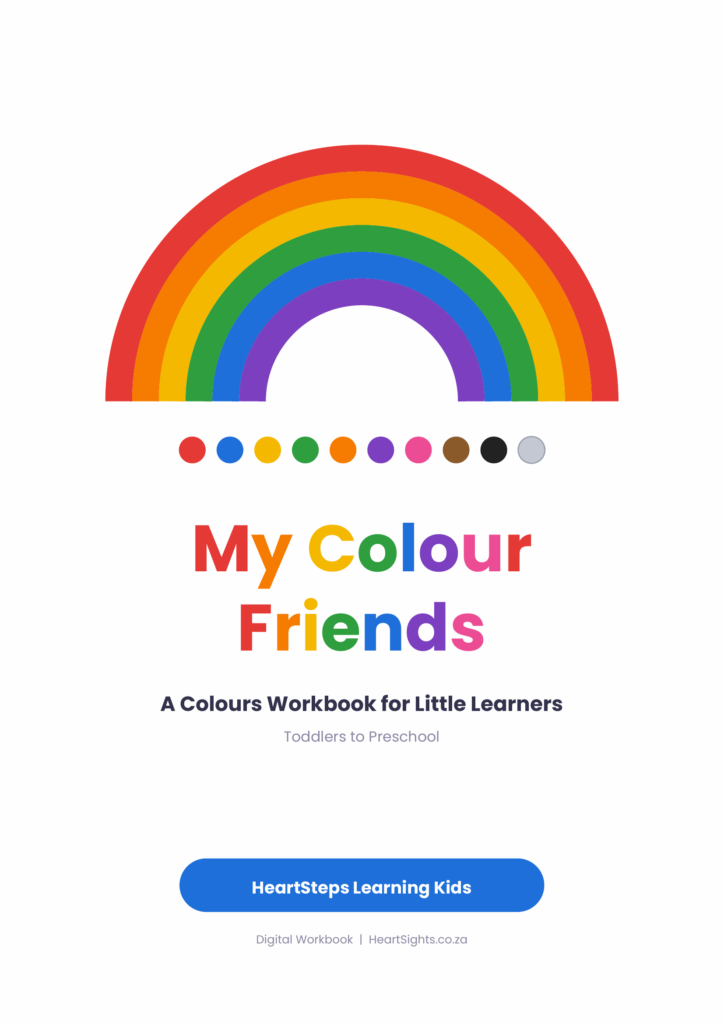
Meet My Colour Friends: A New Colours Workbook for Little Learners

Learning colours should feel like play. That’s why I’m so happy to share my newest HeartSteps Learning Kids workbook: My Colour Friends: A Colours Workbook for Little Learners.

Inside, your toddler or preschooler will meet ten adorable animal friends, one for each colour. A ladybug loves red, a whale loves blue, a duckling loves yellow, and so on. Every page has its own colourful illustration and a short chant that is easy to repeat, which makes it perfect for little voices.

What’s inside this 13-page workbook:

  • A parent note with simple tips for reading together
  • A My Colour Hunt checklist for spotting colours around your home
  • Ten colour pages, each with its own friend and chant: red, blue, yellow, green, orange, purple, pink, brown, black and white
  • A Great Job closing page

How to use it: read a page aloud, point to the colour, say the chant together, and then go on a colour hunt. One page a day is plenty. Little ones learn best when it feels like a game.

My Colour Friends is a digital PDF download, so you can print it or view it on a tablet or phone straight after purchase.

Get your copy here: HeartSights.co.za

Happy learning!
HeartSteps Learning Kids

Do you ever react first and regret it later? 💛

Do you ever react first and regret it later? 💛

You are not too sensitive, and you are not broken. Big feelings are part of being human, and handling them is a skill you can learn.

I’m so happy to share my new workbook: Feel It, Name It, Calm It: An Emotional Regulation Workbook.

Inside this 11-page guided workbook:
✨ The Emotional Reaction Loop
✨ A Name It worksheet with a 0-10 intensity scale
✨ A Trigger Map to spot your patterns
✨ Calming tools: breathing, grounding and tension release
✨ A Pause & Respond tool
✨ A 7-day emotion tracker

Instant PDF download. Print it or fill it in on your device.

Get yours at HeartSights.co.za 🤍

For education and self-reflection. Not a substitute for professional mental health care.

Why Rest Feels So Uncomfortable (And What to Do About It)

Rest

You finally sit down. No tasks, no screen, no one needing anything. And instead of relief, you feel restless, guilty, or oddly anxious. If that sounds familiar, you’re not broken. You’re human.

Why it happens

Many of us learn early that our worth is tied to being useful. Praise comes when we achieve, help, or perform. Over time, the nervous system starts to treat busyness as safety and stillness as a gap where something might go wrong. So when you slow down, your mind rushes in to fill the quiet with to-do lists and self-criticism.

Stillness also lets feelings catch up with you. When life is full of noise, it’s easy to outrun what you’ve been carrying. Rest removes the distraction, and what you’ve been avoiding gets louder.

Three gentle ways to practise rest

  1. Start small. Try two minutes of doing nothing, with no goal and nothing to fix. Build from there.
  2. Name what shows up. Say quietly, “I notice guilt,” or “I notice restlessness.” Naming a feeling softens its grip.
  3. Change the story. Instead of “I’m being lazy,” try “I’m refilling.” Rest is maintenance, not a reward you have to earn.

A closing thought

Learning to rest is a skill, and like any skill it feels awkward at first. Be patient with yourself. The discomfort doesn’t mean rest is wrong for you. It means you’re unlearning something that was never true: that you must always be doing to be worthy.

What helps you slow down? Share in the comments.

New Moon, new intentions 🌙

New Moon, new intentions 🌙I’m so happy to share my new workbook: Manifest with the Moon: An Intention & Manifestation Workbook.

Manifestation isn’t just wishing and waiting. It’s getting clear on what you want, releasing the beliefs that hold you back, and taking small, steady steps toward it.

Inside this 13-page guided workbook:✨

Getting Clear and Setting Your Intention pages✨ A worksheet for rewriting limiting beliefs✨ New Moon and Full Moon rituals✨ Moon affirmations✨ Aligned Action Planner and 7-Day TrackerInstant PDF download.

Print it or fill it in on your device.

Get yours at HeartSights.co.za 🌕#HeartSightsLunarSanctuaries #Manifestation #ManifestWithTheMoon #NewMoon #FullMoon #IntentionSetting #Affirmations #SpiritualGrowth #InnerPeace

An Intention & Manifestation Workbook Cover Page

Lunar Rhythms: A Moon Phase Meditation Journal for Every Season of Your Life

There’s a reason the moon has guided people for thousands of years — through planting seasons, tides, and quiet moments of reflection. It doesn’t rush. It doesn’t stay the same. It moves through darkness, into fullness, and back again, on a rhythm that is patient, predictable, and endlessly repeating.

At HeartSights Lunar Sanctuaries, we believe that rhythm has something to teach us about our own lives. That’s the heart behind our newest release: Lunar Rhythms — A Moon Phase Meditation Journal.

What is Lunar Rhythms?Lunar Rhythms is a 12-page guided PDF journal built around the moon’s eight phases — New Moon, Waxing Crescent, First Quarter, Waxing Gibbous, Full Moon, Waning Gibbous, Last Quarter, and Waning Crescent.Each phase includes:

A short teaching on what that phase representsGentle reflection prompts to help you sit with where you areSpace to write freely, without judgment or a “right” answerAlongside the phase pages, you’ll also find:

A Simple Moon Ritual — a six-step practice you can return to any night, in as little as five minutesA Monthly Moon Tracker — a space to log how each phase feels for you over time, so you can start to notice your own patterns alongside the sky’sWhy work with the moon’s cycle?Most of us move through our days on a straight line — always pushing forward, rarely pausing to notice where we actually are. The moon offers a different model:

one of beginnings, growth, fullness, release, and rest, repeating every month.

Lunar Rhythms isn’t about predicting the future or following strict rules. It’s a quiet, personal practice — a way to check in with yourself as the sky changes above you.Who is this for?This journal is for anyone who:Wants a simple, repeatable reflection practice Feels drawn to the moon, ritual, or cyclical living Is looking for a gentle companion to their existing meditation or journaling habitNo prior experience with moon work is needed — just a willingness to pause and write.

Get your copy Lunar Rhythms is available now as an instant digital download for R229.

👉 https://heartsights.co.za/product/lunar-rhythms-a-moon-phase-meditation-journal/

Lunar Rhythms is the second release from HeartSights Lunar Sanctuaries, following our first product, Grounded: An Anxiety & Grounding Journal. Heart-Centered Stillness for Every Phase of You.

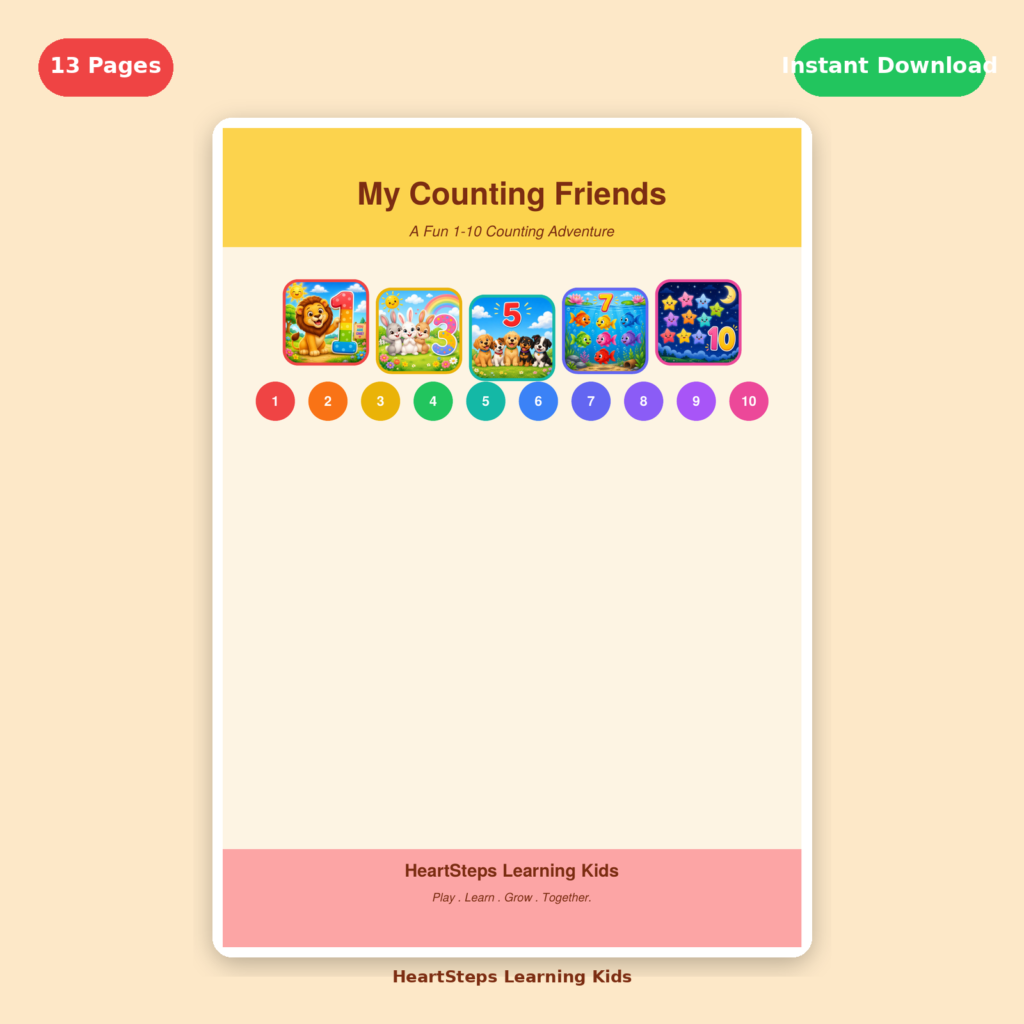
My Counting Friends is here! 🔢

💛Counting made fun, one furry (and feathery!) friend at a time.”My Counting Friends” is a playful numbers workbook for toddlers to preschoolers — perfect for little ones just starting to learn 1-10.Inside, your little learner meets:

1️⃣ Lion

2️⃣ Elephants

3️⃣ Bunnies

4️⃣ Ducks

5️⃣ Puppies

6️⃣ Butterflies

7️⃣ Fish

8️⃣ Birds

9️⃣ Turtles

🔟 Stars

Each number comes with its own count-it-out page, a full set of characters to count, and a sweet little story moment to bring it all to life.✨ 10 number pages✨ Parent welcome note✨ Bright, engaging illustrations✨ Designed for toddlers to preschoolersYours for just R89 💛📥 Get your copy — link in bio💛 Heart-Centered learning for little ones#HeartStepsLearningKids #MyCountingFriends #KidsLearning #PreschoolLearning #NumbersForKids #TodderActivities #LearningThroughPlay

Saying Yes Isn’t Always Kindness

— the workbook is here 💛
If you find yourself saying yes when your whole body is screaming no… this one’s for you.
Inside “Saying Yes Isn’t Always Kindness: A Boundaries & People-Pleasing Workbook,” you’ll find:
✨ Why we over-give (and where it really comes from)
✨ A people-pleasing loop breakdown — so you can spot the pattern in real time
✨ Reflection worksheets to get honest with yourself
✨ A pause-phrase tool for the moment before you say yes
✨ Boundary sentence-starters (so you’re never stuck for words)
✨ A 7-day tracker to help the shift actually stick
This isn’t about becoming “difficult.” It’s about becoming honest — with yourself first.
Your boundaries are not walls. They’re the beginning of relationships you can actually sustain.
📥 Get your copy — link in bio
💛 Heart-Centered Psychology for everyday life
#HeartSightsLunarPsychology #BoundariesWorkbook #PeoplePleasing #SayingYesIsntAlwaysKindness #BoundariesMatter #MentalWellness